Part 5 of our Maritime Canada journey leads us from Halifax’s urban energy to Peggy’s Cove Maritime Canada’s most iconic coastal landmark, then deep into wilderness where Mi’kmaq heritage meets pristine lakes and ancient forests. Sometimes Mother Nature reshuffles your plans—and sometimes those detours lead to the most magical discoveries.
The Farewell to Halifax’s Embrace
Sunday morning at Shubie Campground arrived with that bittersweet feeling every traveler knows—excitement for the adventures ahead mixed with reluctance to leave a place that had welcomed us so warmly. Halifax had exceeded every expectation, but Peggy’s Cove, Nova Scotia’s most famous icon in Maritime Canada, beckoned from the coast just an hour away.
Packing up Bertha felt routine now, though we’d learned to double-check our freshly repaired windshield for any new stress points. The morning air carried that crisp Atlantic freshness that makes Maritime Canada mornings feel like possibilities incarnate. As we pulled out of our campsite for the last time, Lake Charles sparkled in the early light—a perfect farewell from our urban basecamp.
Peggy’s Cove Maritime Canada: When Weather Creates Its Own Magic
The drive from Shubie Campground to Peggy’s Cove took us through classic Nova Scotia coastal countryside—rolling hills dotted with weathered barns, glimpses of blue water between stands of evergreens. We were about to visit Canada’s most photographed lighthouse, determined to discover whether the iconic Peggy’s Cove Maritime Canada destination would live up to its legendary status or prove to be just another tourist trap.
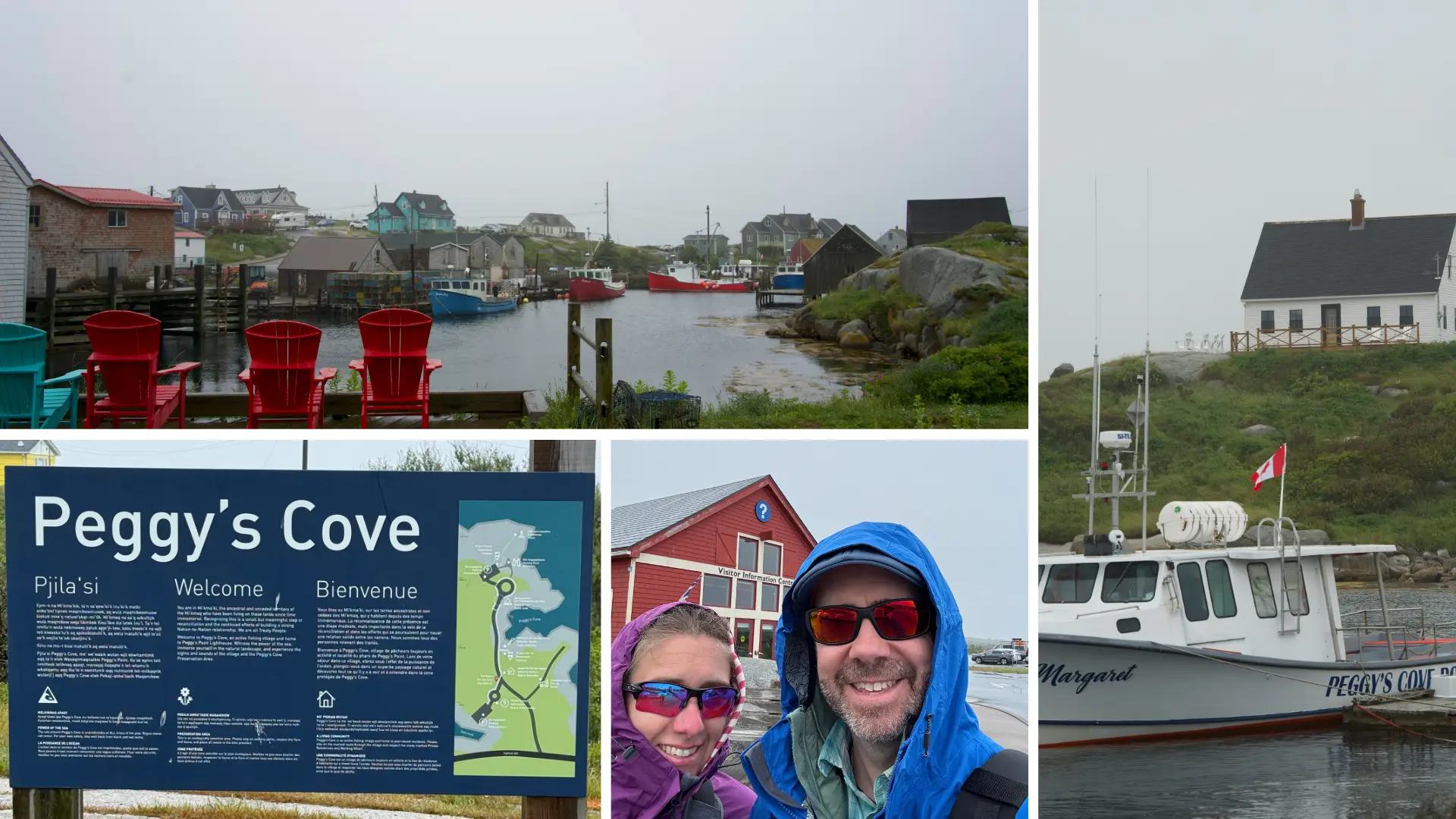
As we stepped out of Bertha at the Peggy’s Cove parking area, the Atlantic weather reminded us immediately why lighthouses were built in the first place. At 56°F with steady rain and fierce winds, this became the coldest day of our entire Maritime journey so far—a dramatic contrast to the warmth we’d experienced elsewhere in Nova Scotia.
Following the tip from our research, we parked Bertha at the Peggy’s Cove Visitor Centre. The short walk from the parking area became part of the experience—approaching this legendary destination on foot while bundled in rain gear allowed us to gradually absorb the atmosphere that makes Peggy’s Cove so special.
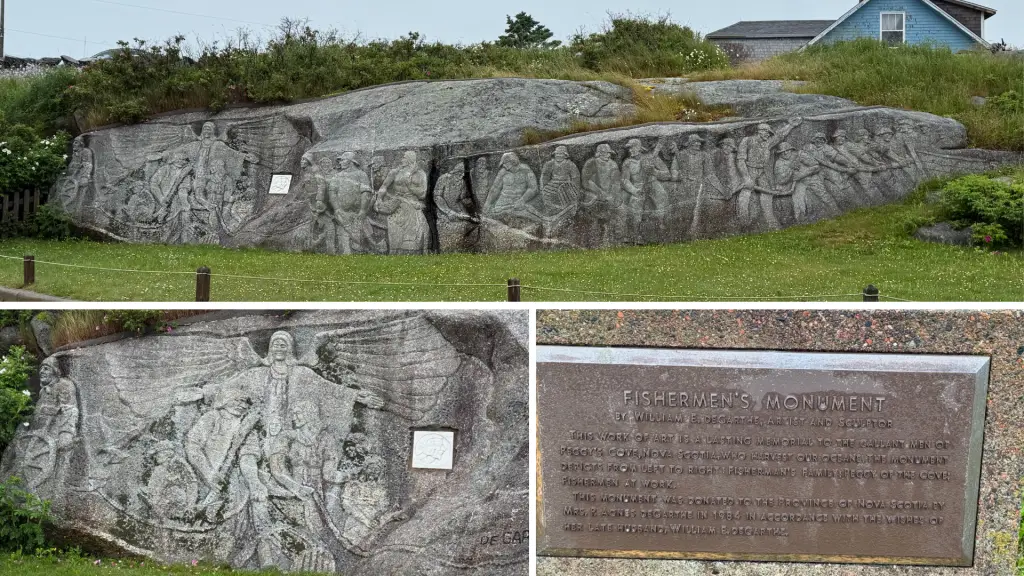
The village unfolded in front of us, weathered wooden buildings painted in classic Maritime colors local shops displaying handcrafted items and small art galleries dotted our path to the famous Peggy’s Cove Lighthouse. One of the these galleries was for a local artist named deGarth had created an extraordinary granite sculpture, beginning this ambitious project in 1977 when he was already 70 years old. Considering that granite is harder than steel, the dedication required for such an undertaking made it even more impressive.
The Beacon That Defines Peggy’s Cove Maritime Canada
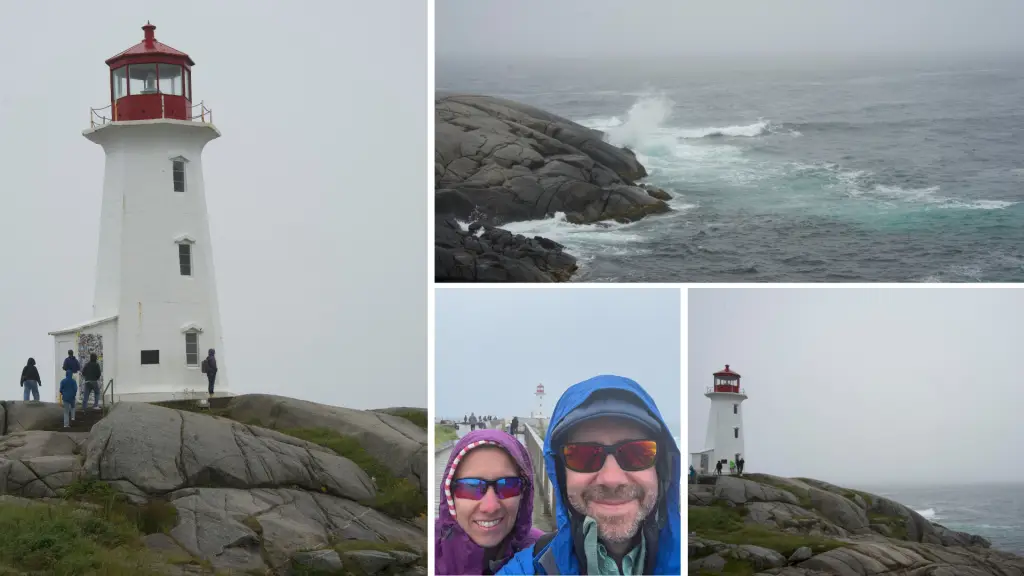
Rounding the final bend, Peggy’s Cove Lighthouse, what struck us was how the stormy weather enhanced the lighthouse’s majesty rather than diminishing it. The massive waves crashed against the granite with thunderous force, wind howled around the lighthouse structure, and the whole scene embodied exactly why these beacons were built to withstand Atlantic fury.
The granite surrounding the lighthouse told geological stories spanning millions of years. The deep grooves carved into the granite told an even more ancient story—these dramatic channels were scored by rocks embedded in glacial ice as massive glaciers retreated thousands of years ago, carving patterns so deep they seemed impossible to believe.
One unexpected benefit of the stormy weather was the reduced crowds. Even on what should have been a busy Sunday, the combination of cold and rain kept many casual visitors away. This also meant we didn’t have to get up early today to rush to get here unlike beautiful weather days where arriving early is essential to avoid the crowds that fill even the secondary parking lot.
The Verdict: Tourist Trap or Treasure?
After warming up with coffee and reflecting on our Peggy’s Cove experience, our verdict was clear: this iconic destination absolutely “passed the test.” While it would certainly be spectacular on a sunny day with calm seas, the dramatic storm conditions revealed the lighthouse’s true character and historical purpose in ways that perfect weather might not have achieved.
Beyond Peggy’s Cove: Maritime Canada’s UNESCO Treasures
Leaving Peggy’s Cove meant bidding farewell to perhaps Nova Scotia’s most famous sight, but our journey toward Lunenburg promised equally compelling discoveries. The UNESCO World Heritage town that had inspired countless maritime stories and shipbuilding legends awaited just over an hour’s drive south along the coast.
The route itself deserved recognition as one of Atlantic Canada’s most scenic drives. Highway 3 wound through coastal communities where lobster traps stacked like geometric sculptures, weathered fishing boats rested in protected harbors, and every turn revealed new perspectives on the relationship between Nova Scotians and their Atlantic environment.
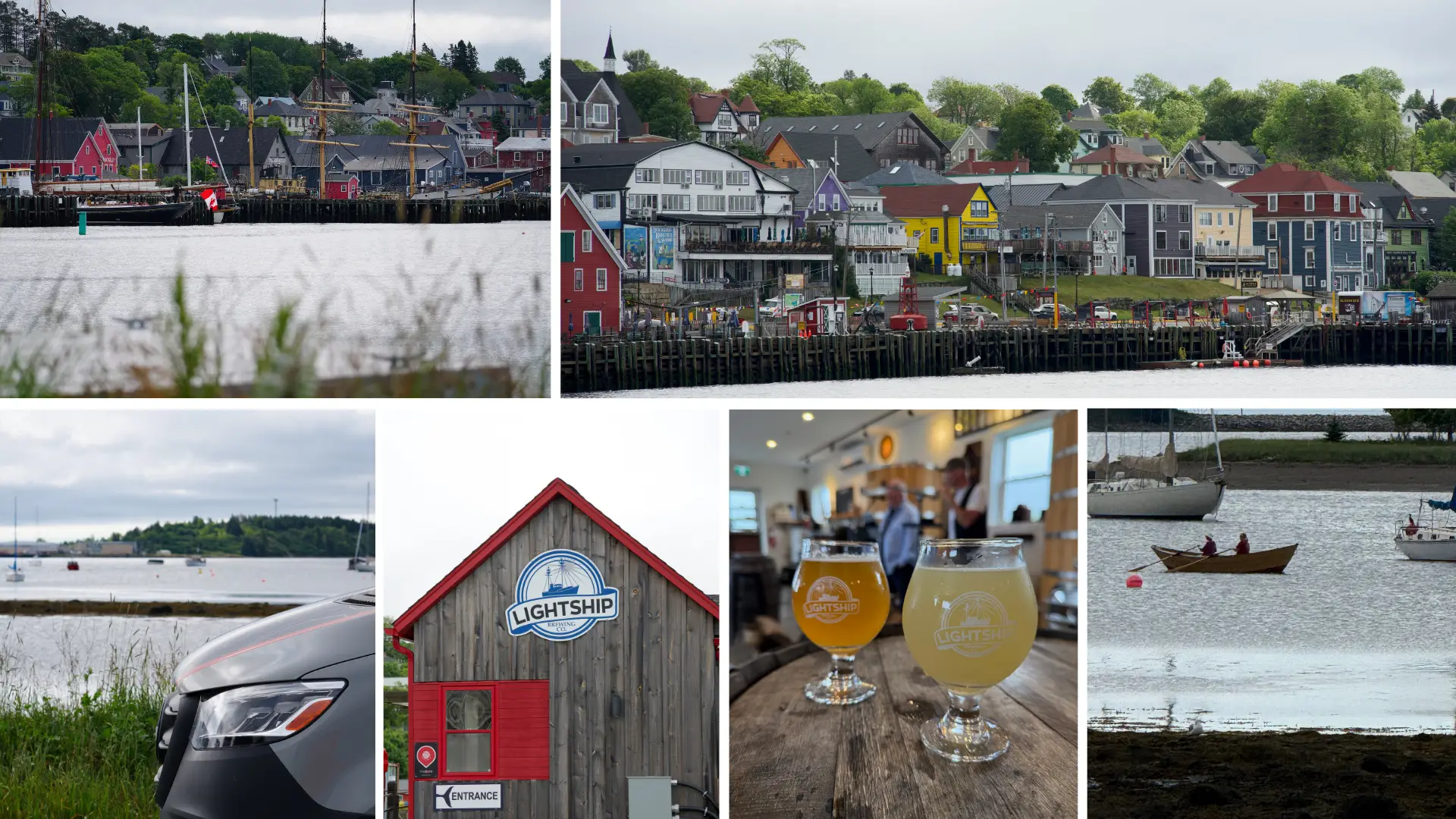
Lunenburg greeted us through sheets of rain that turned the town’s famous colorful buildings into impressionistic watercolor paintings. This UNESCO World Heritage Site earned its designation because approximately 70% of the original structures from the 1700s remain intact—one of the best examples of a planned British colonial settlement in North America.
Our ambitious plans for the day had included touring the legendary Bluenose II, exploring the comprehensive Fisheries Museum of the Atlantic, and wandering through downtown Lunenburg’s historic streets with the leisurely pace that such extraordinary places deserve. But Atlantic weather had other ideas, and we had to adapt rather than resist.
The rain created practical challenges beyond tourism disappointment. After arriving at our Harvest Host location, we had to make a 15-minute walk through misty rain to a grab a quick bite for a late lunch.
Lightship Brewery: Harbor Views and Harvest Host Hospitality
Located directly on Lunenburg’s harbor, Lightship Brewery, our Harvest Host location for the night, offered everything weary travelers could want: exceptional craft beer and live music, and—when the clouds occasionally parted—incredible views Lunenburg Harbour. The brewery embodied that perfect combination of local charm and visitor welcome that makes Harvest Host locations so special for van life travelers. From our table, we could see the museum we’d planned to explore and the legendary schooner we’d hoped to tour, but instead of feeling disappointed, we found ourselves appreciating this different perspective on Lunenburg’s maritime heritage.
Tip: If you are a Harvest Host member, Lightship Brewery’s location makes it the ideal base camp for Lunenburg exploration with a short 15 minute walk to town.
Monday: Breaking Through the Clouds
Monday morning brought the weather we’d been hoping for throughout our Maritime Canada adventure. As we emerged from Bertha to clean up and prepare for the day ahead, brilliant sunshine transformed our harbor view completely. What had been merely a parking spot the night before revealed itself as a spectacular waterfront location with clear views across to Lunenburg’s historic harbor. As we departed Lightship Brewery we headed of to the next part of our adventure: Kejimkujik National Park.
Kejimkujik National Park Seaside: Where Forest Meets Atlantic
Kejimkujik National Park is split into two distinct sections. We first stopped to explore the Seaside portion, an isolated section of the park protects a pristine stretch of Atlantic coastline. The contrast with our previous day’s weather was dramatic: we set off on our hike under brilliant sunshine with temperatures climbing toward 78°F—a 23-degree improvement from Peggy’s Cove’s frigid conditions.
The two-kilometer core trail became a journey through multiple ecosystems—dense maritime forest giving way gradually to coastal scrubland, then finally opening onto a shoreline that looked exactly like what early European explorers must have encountered centuries ago. The forest section provided welcomed shelter and calm, but as we approached the ocean side of the peninsula, the sea breeze created perfect cooling conditions.
Tip: Bring binoculars if you have them, while we didn’t see any seals they often swim close to the shore and if you’re lucky you can catch a glimpse of them.
As we reached Kejimkujik Seaside’s beaches, massive glacial boulders dotted the coast and bright white sand stretched out in front of us and appeared devoid of beach goers. The emptiness wasn’t accidental—piping plovers, an endangered species, nest in these protected areas. The massive glacial boulders, or erratics, scattered across the beach in formation geologists call drumland or glacial junk essentially a glacial debris field. This was definitely a trash heap that we could live in.
There is a saying that “A bad day out on the trail is better than any day in the office”. This was better than a bad day, it is was a day that makes you not want to go back to the office.
Into the Heart of Kejimkujik: Lakes, Rivers, and Ancient Stories
The drive from Kejimkujik Seaside to the main portion of Kejimkujik National Park took us deeper into Nova Scotia’s interior, where the landscape transformed from coastal regions to something resembling the legendary wilderness of Canada’s vast interior.
Along the route, we made an unexpected discovery related to Nova Scotia’s agricultural significance. We learned that the Lunenburg area is designated as “Christmas Tree Capital of the World,” supplying Christmas trees to both Canadian and U.S. markets. The evidence was everywhere once we knew to look—perfectly maintained evergreen forests managed specifically for holiday harvest.
Kejimkujik National Park and National Historic Site protects a vast wilderness spreads across multiple lakes, rivers, and forest communities that invite exploration.
Jeremys Bay Campground: Reality Check on Canada Day
Jeremys Bay Campground provided a dramatic lesson in timing and expectations. Our arrival coincided with Canada Day, transforming what we’d hoped would be a peaceful wilderness camping experience into something quite different. With over 400 sites packed into concentrated areas, it was difficult to enjoy the peacefulness of the wilderness. We also had an internal site which meant we had other campers on all for sides with little to no separation.
Our campsite, while not offering the privacy of smaller campgrounds, put us within walking distance of Jeremy’s Bay on Lake Kejimkujik. Despite the crowds, the campground’s new facilities impressed us with their cleanliness and modern amenities, while group programs and easy trail access made it clear why families choose Kejimkujik for multi-generational camping adventures.
The Great Escape
By the next morning, we were ready to get away from the crowds and head off to our next adventure. Our experience with Canada Day crowds provided valuable perspective on our travel preferences and the reality of popular destinations during peak season. In the future we’ll take a little more time to research our camping options to make sure we’re picking sites that will give us the level of solitude we’re looking for, or at least select a site on the outer ring we only have campers on three sides.
Experience Our Peggy’s Cove Maritime Canada Adventure
Want to see Peggy’s Cove Lighthouse battling dramatic Atlantic storms, feel the magic of those pristine Kejimkujik beaches, and witness our seal encounters up close? Check out our YouTube
What Awaits: Where History Shaped a Continent
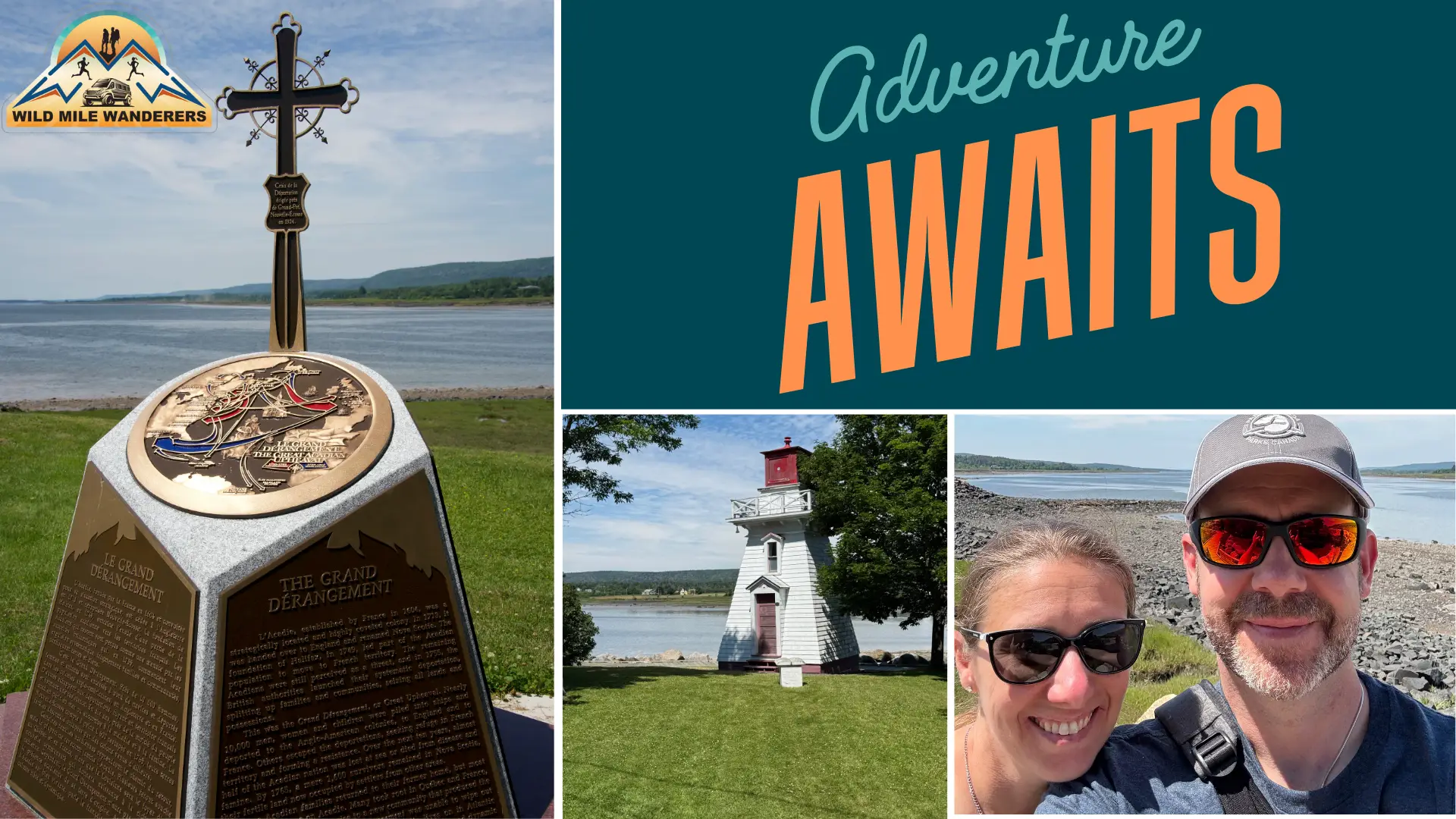
As we prepare to leave Kejimkujik’s pristine wilderness behind, our Maritime journey takes us to places where the very foundations of North America were laid. Annapolis Royal—older than Plymouth, Jamestown, and Quebec City—awaits with stories that stretch back over 400 years, where French dreams and British ambitions shaped the destiny of an entire continent. We’ll walk through Grand-Pré National Historic Site, where the tragic and beautiful story of the Acadians unfolds across landscapes.
This is Part 5 of our comprehensive Maritime Canada adventure series. Catch up on our complete journey:
Stay tuned for Part 6 as we explore the historic heart of Acadia, where the stories that shaped North America come alive in landscapes of breathtaking beauty and profound cultural significance.