There’s something profound about standing where history was made, breathing the same salt air that filled the lungs of 18th-century French colonists. This Nova Scotia heritage journey will take you through one of Canada’s most remarkable cultural destinations, where French colonial history meets Scottish immigration stories. As we rolled away from Broad Cove Campground, we finally had a clear day to truly appreciate Cape Breton’s rugged coastline. Though our morning began with the unwelcome discovery of a cracked windshield—one of those inevitable van life realities that remind you not every day is a van life Instagram post —it still didn’t dampen our excitement for what lay ahead.
Entering the 18th Century: Fortress of Louisbourg
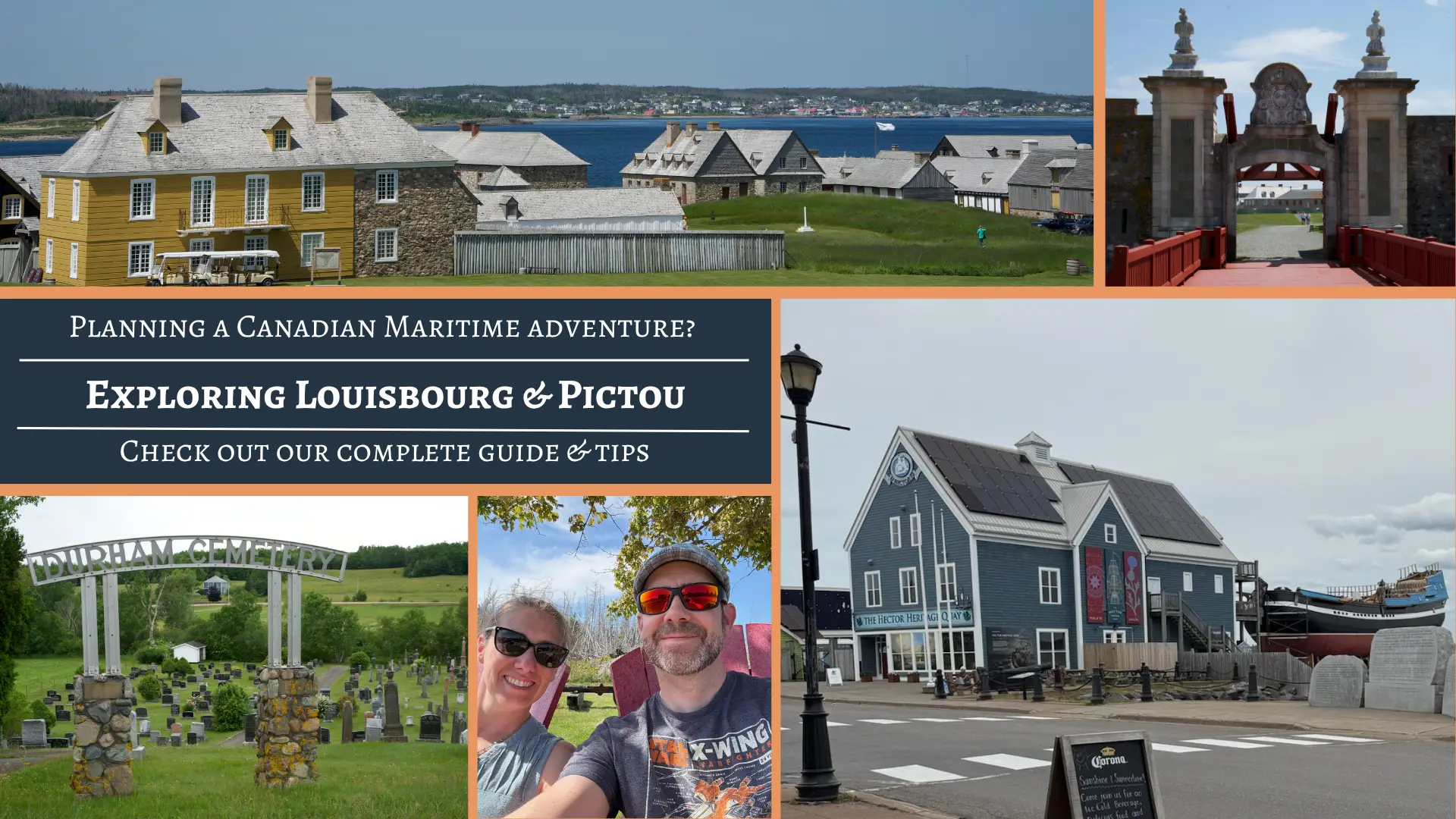
The Fortress of Louisbourg National Historic Site was our first stop of the day, a key stop on any Nova Scotia heritage journey. Built by the French between 1719 and 1745, this wasn’t just another historic site—it was a fully reconstructed 18th-century world, complete with costumed interpreters. Walking through the gates felt like crossing into another time. We were surrounded by the clang of blacksmith hammers, the aroma of bread baking in wood-fired ovens, and the sight of women in period dress going about their daily tasks exactly as their predecessors had 280 years ago.
The sheer scale immediately distinguished this from any fort we’d previously explored. We learned as part of the tour the difference between a fort and a fortress. Where typical forts are meant to house military forces and might occupy a few acres a fortress is a fortification around an entire town or community. The current National Historic Site includes reconstructions of approximately 25% of the original fortress on its original foundations. The remaining 75% are only archaeological ruins marked by interpretive signs—a sobering reminder of just how vast this 18th-century stronghold had been.
Tip: If you visit be sure to download the Parks Canada which has free audio tours of the site you can download and listen to while you wander through the historic building and ruins.
We didn’t just learn about the military history, but also the trade that made the Fortress so valuable to whatever country control the colony. Louisbourg was a hub for export exporting salted cod which could be edible for up to two years if stored properly. The North Atlantic fisheries were more valuable to France than even the fur trade and Louisbourg exported more than 15 million pounds of salted codfish annually.
The fortress’s tragic military history unfolded through exhibits and costumed interpreter. The first British siege in 1745, just months after construction completed, saw 3,500 New England soldiers surprise the poorly trained 700-man French garrison by approaching overland rather than by sea. After the peace treaty returned Louisbourg to France, the British repeated the exact same strategy in 1758—and this time, they leveled the entire fortress rather than risk losing it again.
One of the most interesting facts we learned was about the French desperate final defense to fill the tunnels under Louisbourg with black powder so they could destroy the fortress before if the British were to breached the walls. What the French didn’t consider was the level of Cape Breton’s coastal water tables, which flooded the tunnels, rendering the plan useless. These tunnels still exist under the fortress but are not accessible due to the flooding.
Standing in the fortress courtyard we understood why visitors typically spend entire days here. We were only about to spend three hours but could have easily spent a full-day taking in everything the Fortress of Louisbourg had to offer.
Sydney’s Musical Welcome: The World’s Largest Fiddle
Before heading to our campground for the night we continued our endeavor to visit the world’s “largest” roadside attractions with a visit to the world’s largest fiddle in Sydney. The fiddle stands over 60-foot tall, weighs over 8 tons, took 18 months to construct, and plays music from speakers embedded in the fiddle. The fiddle was constructed as a monument to Celtic tradition—as a tribute to the Scottish heritage that has defined this region for centuries.
Battery Park Provincial Campground
As our day came to a close, we headed over Battery Park Provincial Campground in St Peters, Nova Scotia. The small provincial campground, only about 40 camp sites, is located right next to the St Peters Canal National Historic site. The campsites are well spaced and fairly private, many have beautiful ocean views overlooking St Peters Bay. This was the perfect stop midway between Loiusbourg and Pictou where our adventures would continue the next day.
Our Nova Scotia Heritage Journey Becomes Personal: Scottish Roots in Pictou
Our drive to Pictou carried more than typical tourist anticipation—we were heading toward potential answers about our own Scottish heritage. The McCulloch House Museum & Genealogy Centre proved why sometimes the smallest places hold the biggest treasures. The moment we walked through those doors, we knew we’d found something special. The staff didn’t just assist visitors—they became detective partners in unraveling family mysteries.
After a couple of hours of research assisted by the staff at McCulloch House, the breakthrough moment came when curator Teresa McKenzie’s husband—himself a McKenzie—arrived and provided the missing pieces we’d been searching for throughout our Nova Scotia heritage journey.
“These were the sawmill McKenzies,” he explained, and suddenly our family fragments coalesced into documented history. Daniel and John McKenzie, brothers who’d established not just a sawmill but an actual stone quarry in the Durham area outside Pictou. Their quarried stone had been used in PEI’s legislature building and other significant Maritime construction projects. These weren’t just Scottish immigrants scraping by—they were substantial landowners who’d owned 300 acres and played prominent roles in Nova Scotia’s early development.
Culinary Comfort at Nook & Cranny
After hours of emotional genealogical discovery, hunger led us to Nook & Cranny Restaurant. The outdoor seating offered perfect views of Pictou harbour, where Scottish immigrants first set foot in 1773 on the famous Hector Quay. The lunch highlight was the lobster roll—fresh Maritime lobster on a perfectly toasted bun for just $25 CAD— which represented everything wonderful about Nova Scotia’s approach to food: simple, fresh, and reasonable.
The Hector Heritage Quay: Scottish Immigration Stories
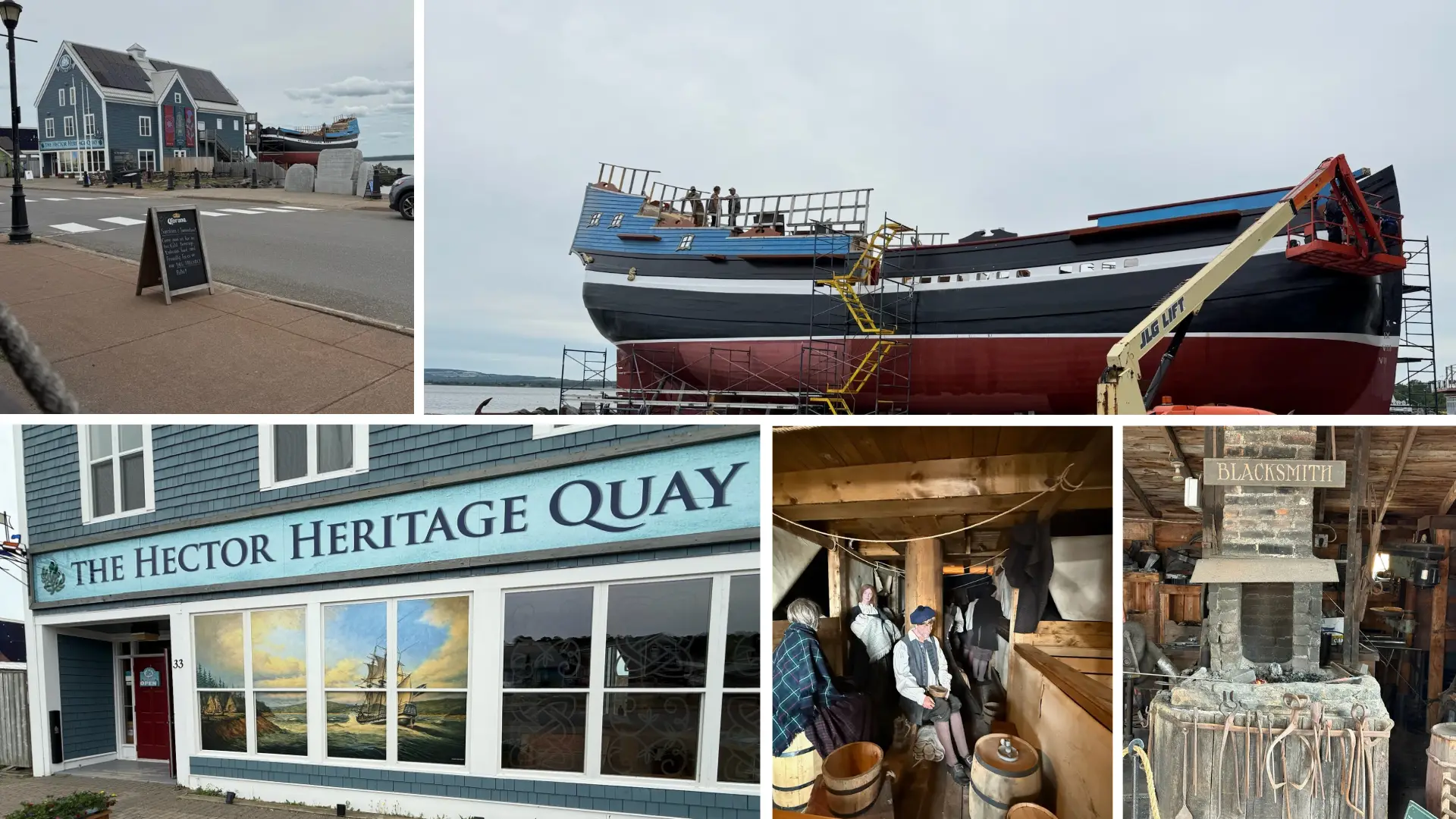
The Hector Heritage Quay felt like the universe’s perfect punctuation mark on our genealogical journey. This small museum, dedicated to the ship that brought the first Scottish emigrants to Nova Scotia in 1773 and is a must see on any Nova Scotia heritage journey. Unlike other forced emigrations, these Scottish Highlanders had been recruited by Philadelphia land speculators who promised cleared farmland ready for cultivation. The reality proved starkly different—dense forest requiring clearing, a voyage that stretched from six weeks to eleven, and arrival with virtually no supplies just as winter approached.
That 200 Highland passengers had been crammed aboard a cargo vessel designed for freight, not people, made their survival even more remarkable. The Mi’kmaq tribe proved instrumental in teaching these tree-inexperienced Highlanders essential survival skills—snowshoe construction, hunting techniques, and forest management—enabling them to endure that first brutal winter and eventually thrive.
The museum’s crown jewel—a full-sized replica of the Hector—was unfortunately still under restoration during our visit. Hurricane Juan in 2003 had damaged the original replica, lightning had subsequently destroyed the masts, and extensive rebuilding was scheduled for completion in July 2025, just weeks after our visit. If you interested in seeing the relaunch of the Hector, you can check it out here: Hector Launch
Sweet Endings: Mrs. MacGregor’s Shortbread
Every meaningful journey deserves a sweet conclusion, and Mrs. MacGregor’s Shortbread provided ours with authentic Maritime flair. This family recipe, over 200 years old, connected us once more to the Scottish traditions that had traveled across oceans to take root in Nova Scotia soil. The ginger shortbread—our clear favorite—carried flavors that seemed to hold centuries of tradition in each buttery crumb.
Finding Family in Durham Cemetery
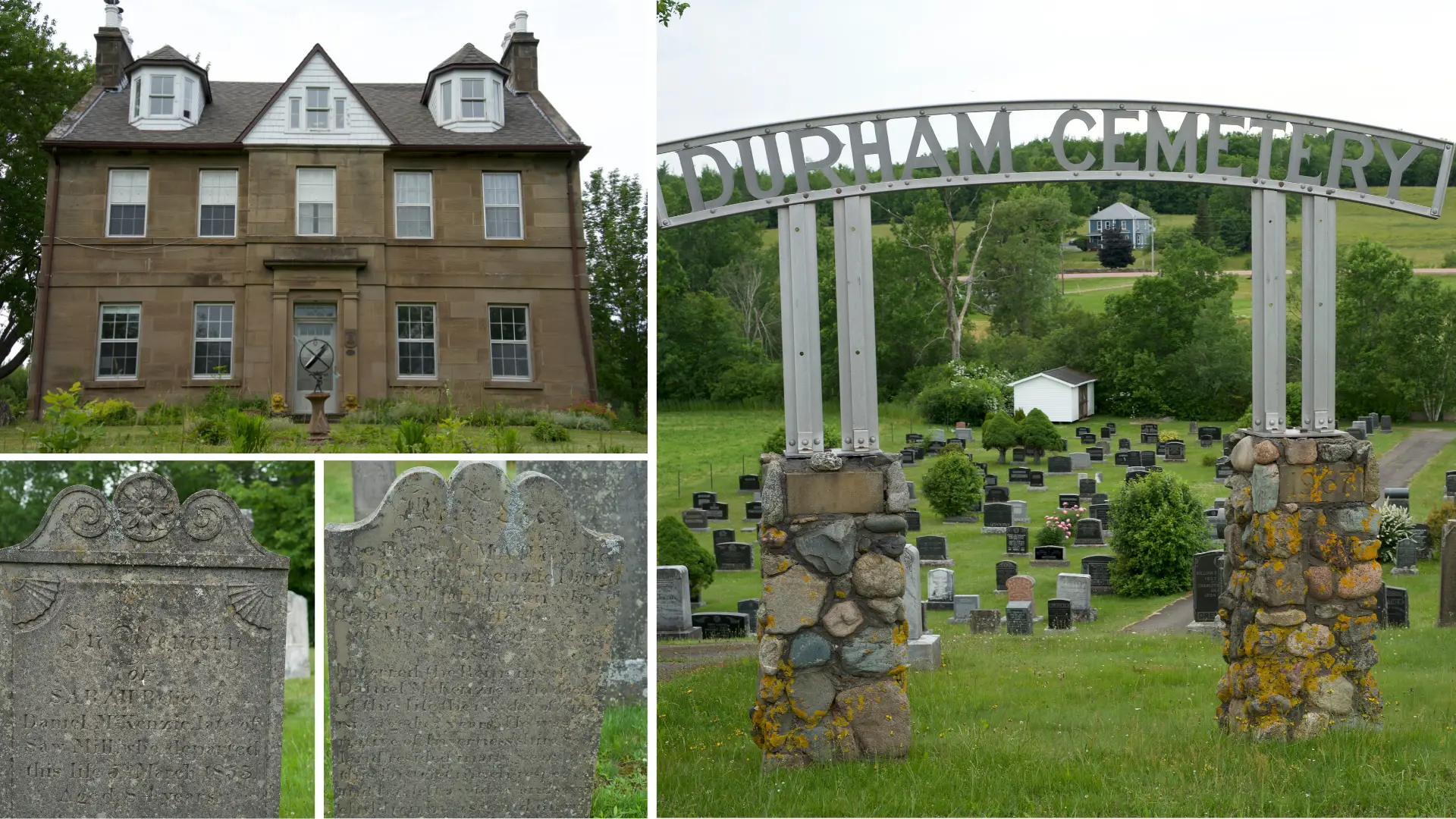
We wrapped up our Pictou visit with a drive out to Durham Cemetery to visit the burial sites of Daniel and John McKenzie. Daniel McKenzie’s gravestone, though worn by Maritime weather, still clearly recorded his story: “Native of Invershire, Scotland, resident years in this district, much respected and left a widow and several children.” Sarah, his second wife, had outlived him by decades—she died in 1853 at age 84, while Daniel passed in 1815 at just 62.
Reading those inscriptions while standing on land our ancestors had worked and shaped, we understood how genealogy research transcends simple name-collecting. This was about understanding the courage required to leave everything familiar, the resilience needed to build new lives in an unforgiving landscape, and the legacy that connects contemporary travelers to historic footsteps across this same Maritime soil.
Reflections at Caribou/Munroes Island Provincial Park
As we finished up an amazing day of discovery in Pictou we made the short drive to our campsite at Caribou/Munroes Island Provincial Park. The campground is located right on the Northumberland Strait. After getting settled in we should the easy path from the campground right down to the beach. Standing on the rocky shoreline, watching the ferry that connects Nova Scotia to Prince Edward Island, we reflected on everything we learned about our heritage today.
Watch Our Nova Scotia Heritage Journey Unfold
Watch our complete Nova Scotia heritage adventure on YouTube, where you’ll experience all of the ups and downs of travels, genealogical discoveries, and get the full story of our windshield crisis that reminded us why road trip flexibility matters.
Subscribe to our YouTube Channel
Don’t forget to subscribe to Wild Mile Wanderers for more heritage travel adventures that go beyond the surface.
What Awaits: Halifax’s Urban Maritime Magic
As dawn breaks over our campsite at Caribou/Munroes Island Provincial Park, the road ahead leads us toward Nova Scotia’s vibrant capital. Halifax promises a different kind of Maritime experience—where urban sophistication meets deep nautical tradition, and where some of history’s most tragic and triumphant maritime stories converge. Plus, we’ll finally get that windshield fixed—because sometimes the most mundane travel necessities lead to the most unexpected urban discoveries.
Stay tuned for Part 4, where Halifax’s historic waterfront beckons with world-class museums, culinary adventures, and maritime stories. This Nova Scotia heritage journey represents just one part of our Maritime Canada adventure. Check out the rest of our adventure here:
Have you traced your own Maritime heritage or explored the connection between Scottish Highland immigration and Maritime Canada? Share your Nova Scotia family connections in the comments below—we’d love to hear how this incredible province has shaped your family’s story.
Disclaimer: Some links in this post are affiliate links, meaning we earn a small commission if you make a purchase at no additional cost to you. We only recommend products and services we’ve personally tested during our travels and outdoor adventures.