

Introduction: The AI Travel Planning Revolution
Planning the perfect getaway or vacation typically takes hours of research, guidebook flipping, and scrolling through endless TripAdvisor reviews. With the advancements in artificial intelligence, can AI travel agents help simplify this process. In theory, it would be great to simply tell AI where you are going, your interests, and the types of food you enjoy and have it provide a custom itinerary in seconds.
In this post we’re going to try to answer the question, Can an AI digital travel agent truly deliver a tailored itinerary that rivals traditional planning methods? To find out, we are conducting a practical experiment using three leading AI platforms—ChatGPT, Gemini, and Perplexity—to plan a winter trip to Portland, Maine. This coastal New England city, with its blend of maritime history, culinary excellence, and natural beauty, provides an ideal test case for evaluating AI travel planning capabilities.
Magai: The AI Platform Powering Our Experiment
For this travel planning experiment, we utilized Magai, an advanced AI platform that enabled us to systematically evaluate how different AI models approach the same travel planning challenge. Magai is an AI orchestration platform that provides users access to multiple large language models, allowing you to select the right model for your particular use case.
The Magai platform allowed us to streamline testing and eliminated the need to log into multiple AI platforms. This allowed us to focus on the substantive differences in the quality, creativity, and usefulness of each of the AI model recommendations rather than differences in how each platform receives and formats inputs.
Methodology: The Travel Planning Challenge
For our experiment, we presented each AI model with identical instructions:
“ Plan a winter weekend in Portland, Maine for early 2025. We’re Marriott Platinum members and this is a birthday celebration. Include both indoor and weather-dependent outdoor activities. Focus on verified businesses and seasonal opportunities.”
After that, we followed up with more specific prompts requesting recommendations for hotels, restaurants, and activities plus a complete itinerary based on those recommendations. These prompts were deliberately structured to evaluate how well each AI model could:
- Provide specific, actionable recommendations
- Account for our preferences, things like asking for non-seafood restaurant recommendations
- Create a balanced itinerary reflecting both indoor and outdoor activities
- Demonstrate knowledge of local establishments and attractions
- Account for seasonal establishments
- Organize information in a useful, time-sensitive format
Let’s explore how each platform performed.
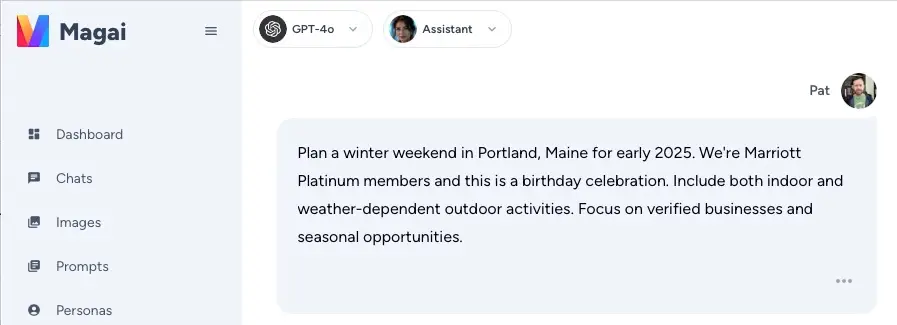
ChatGPT
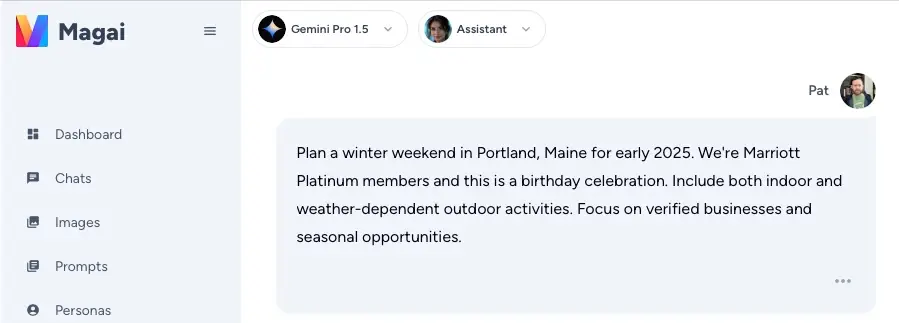
Gemini

Perplexity
Download the complete prompt here:
AI Travel Agents: Common Recommendations
You would assume when asking each of the AI models for specific recommendations for hotels, restaurants, and activities in the relatively small city of Portland, Maine you would have a lot of common recommendations. While that was true for the hotel recommendations where 3 out of the 5 suggested hotels were recommended by more than one of the AI models the same wasn’t true for the restaurants or activities. Only 5 of the 21 recommended resturants and 7 of the recommended activities were common across more than one model.

AI Travel Agents: Differences
ChatGPT: Structured Responses

ChatGPT approached the task with comprehensive detail and structure. For example, for each of the recommended restaurants, ChatGPT provided information on the type of cuisine served, price point, restaurant features, if reservations are required, and any seasonal considerations. It was also the only AI model that provided a complete day-by-day itinerary based on only the initial prompt.
Complete Chat GPT Response:
Gemini: Inquisitive AI
Gemini’s approach to responding to the prompts differed from the other two models. It was the only AI model that asked for additional data or context after the initial prompt asking questions about the weekend we planned to travel as well as the hotel style we preferred. Since we were using a standard set of prompts and didn’t respond to Gemini’s questions we may not have gotten the optimum results from Gemini.
Complete Gemini Response:

Perplexity: Real-time Internet Access
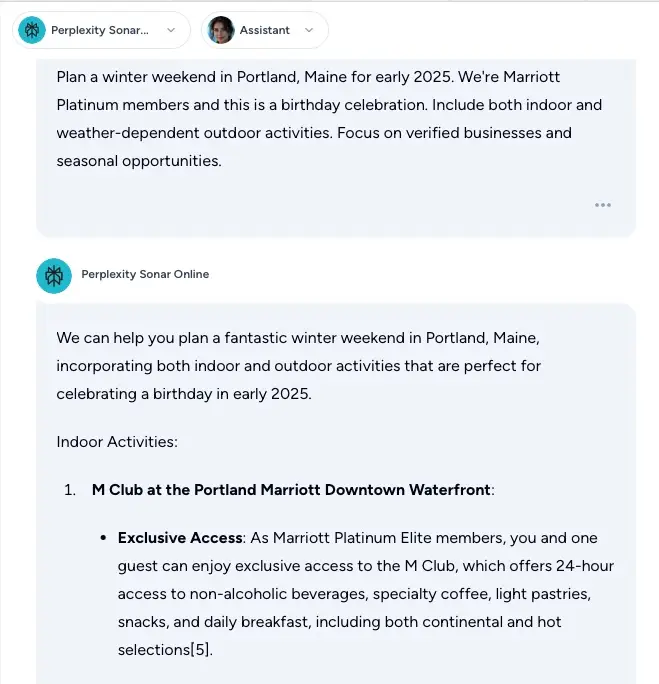
Based on Perplexity’s responses, it was obvious it was the only AI model we tested with access to current resources on the web. Perplexity provided the largest number of activity recommendations, with 17, and the recommendations included different local events like the Portland Hot Chocolate Sip-Off that occurred in January. Perplexity also provided recommendations outside of traditional tourist locations including things like an Arcade bar for those Gen Xers out there who like to play old arcade games while you have a drink.
Complete Perplexity Response:
Initial Thoughts
As expected, not everything was perfect in the AI model responses. Some of them recommended activities or restaurants that are closed during the winter season, and one of them even recommended a hotel in Portland, OR. Check out our video below with more details on how we used Magai to plan out Portland, Maine vacation.
Now that we are armed with the AI model recommendations, we’ll be following them for our weekend trip up to Portland, Maine. Stay tuned for the next post, where we’ll tell you how well AI planned our trip, go over a detailed comparison of the different models, and our thoughts on whether we’ll be using AI to help with our travel planning in the future.
